
Recently, Nature Communications published online a research paper titled “Nanofluidic sensing inspired by the anomalous water dynamics in electrical angstrom-scale channels” by Distinguished Research Fellow Zhang Bowei and colleagues from the School of Mechanical and Power Engineering at East China University of Science and Technology. The paper reports the team's progress in two-dimensional nanofluidic sensing, establishing a precise control strategy for sensing selectivity and response/recovery speed by proposing a method that rapidly and accurately regulates confined molecular dynamics within two-dimensional channels through the combination of an external electric field and ion doping.
Image Caption: Paper-related information
Gas and humidity sensors are widely used in modern industry, environmental monitoring, agriculture, healthcare, and daily life. To address the current limitations of gas/humidity sensors—such as the inability to promptly capture gas concentration changes and low sensitivity in detecting low-concentration analytes—which hinder their application in extreme environments, the research team innovatively proposed a two-dimensional fluidic confinement sensing strategy. This approach uses a hierarchically structured two-dimensional transition metal carbide (Ti₃C₂ MXene) to provide two-dimensional sensitive channels, optimizing both sensor response and recovery speed by combining metal cation intercalation with electric field manipulation. By integrating molecular dynamics simulations, first-principles calculations, multiphysics simulations, and in situ spectroscopic experiments, the researchers discovered that low electric currents cause water molecule polarization, leading to ordered dense packing of confined water within the two-dimensional channels. In contrast, high electric currents induce the dissociation of confined water, causing it to aggregate into large molecular clusters that block the channels. Through electric field and cation regulation, the team achieved a controlled transition of confined two-dimensional water among three structural types: monomer ⇋ dimer ⇋ cluster. This strategy enables rapid regulation of confined molecular transport dynamics within two-dimensional channels, with potential applications in sensing, water treatment, gas separation, energy storage, and conversion.
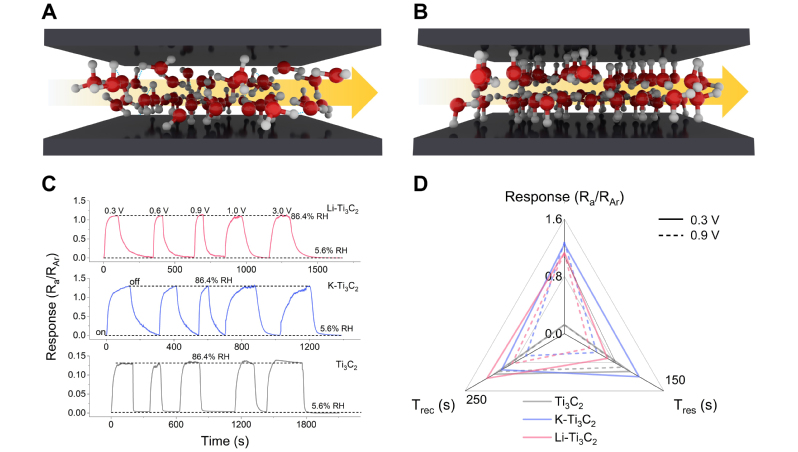
Image Caption: Electric field regulation of confined water structure evolution in two-dimensional channels and optimization of two-dimensional confinement sensing performance
This research was completed with East China University of Science and Technology as the corresponding affiliation. Chu Tianshu, a doctoral student from the School of Mechanical and Power Engineering, is the first author, and Distinguished Research Fellow Zhang Bowei and Professor Xuan Fuzhen are the co-corresponding authors. The work was supported by the National Natural Science Foundation of China Innovative Research Group, the National Natural Science Foundation of China General Program and Young Scientists Program, the Shanghai Basic Research Pilot Zone Program, and other funding sources.
Original Article Link: https://doi.org/10.1038/s41467-024-51877-7

