
Recently, the journal Nano Letters reported a research work on multimodal chemical sensing based on single-atom catalysis conducted by Zhang Bowei and colleagues from the School of Mechanical and Power Engineering at East China University of Science and Technology.
Ascorbic acid (AA), dopamine (DA), uric acid (UA), and nitric oxide (NO) participate in various physiological and pathological processes in living organisms. Quantitative detection of these molecules is essential for the effective prevention and diagnosis of related diseases. Currently, such sensing is predominantly based on noble metal catalysts with single detection capability, failing to meet the demands of low-cost and multifunctional applications.
To address this challenge, the research team proposed a synthetic strategy for fabricating "high-loading dual-structure single-atom" catalysts by selectively removing some outer-layer Ti atoms and surface O groups from two-dimensional Ti₃C₂, enabling dense and uniform distribution of Pt atoms on the surface and interfaces (SA Pt–Ti₃C₂). Experimental and theoretical calculation results show that the adjacent coordination structures exhibit significant synergistic effects, endowing SA Pt–Ti₃C₂ with excellent sensing performance for AA, DA, UA, and NO. With the support of machine learning algorithms for analyzing multiple sensing signals, accurate prediction of multi-component concentrations in mixtures was achieved. Thus, this work provides guidance for the application of multimodal sensing.
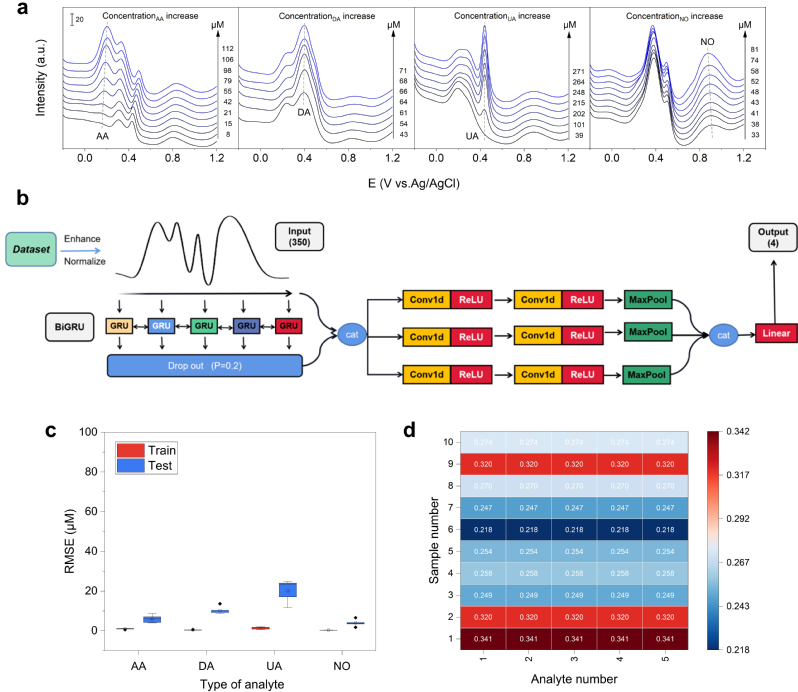
Image Caption: Multimodal sensing testing, signal analysis, and prediction
This research was completed with East China University of Science and Technology as the corresponding affiliation. Chu Tianshu, a doctoral student from the School of Mechanical and Power Engineering, is the first author, and Distinguished Research Fellow Zhang Bowei and Professor Xuan Fuzhen are the co-corresponding authors. The work was supported by the National Natural Science Foundation of China Innovative Research Group, the Shanghai Basic Research Pilot Zone Program, and other funding sources.
Original Article Link: https://doi.org/10.1021/acs.nanolett.4c02428

