
From October 24 to 25, the 3rd National Symposium on Small Specimen Mechanical Testing Methods and the 1st China Innovation Exchange on Mechanical Testing Instruments and Equipment were held by the Fuchun River in Tonglu, Zhejiang Province. The conference brought together nearly 300 representatives, including academicians, experts, scholars, graduate students, and professionals from mechanical testing instrument and equipment enterprises, representing 87 institutions nationwide. Participants engaged in in-depth discussions on theories, technologies, methods, and standards in the fields of non-destructive, minimally destructive, and small-specimen mechanical testing, as well as innovative advancements and future development trends in advanced mechanical testing instruments and equipment.
Our university served as a co-organizer of the conference and the host institution for the Working Group on Mechanical Properties Test Methods for Small Specimens of Metallic Materials. President Xuan Fuzhen led a delegation from our university to the conference, which included Academician Tu Shandong, Professor Guan Kaishu, and Professor Zhou Guoyan.
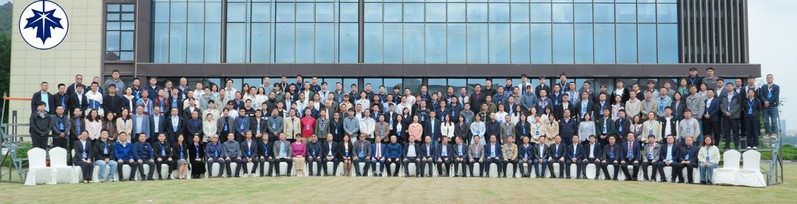
Photo caption: Group photo of conference participants
At the opening ceremony, President Xuan Fuzhen delivered a speech. He reviewed the evolution of mechanical property testing technology from macroscopic, destructive methods toward microscopic, minimally destructive, and even future non-destructive approaches. He also shared our university's long-standing accumulation and foundational work in the field of material mechanical testing, particularly in small specimen technology. He further announced that the next session of the conference would be hosted by East China University of Science and Technology.
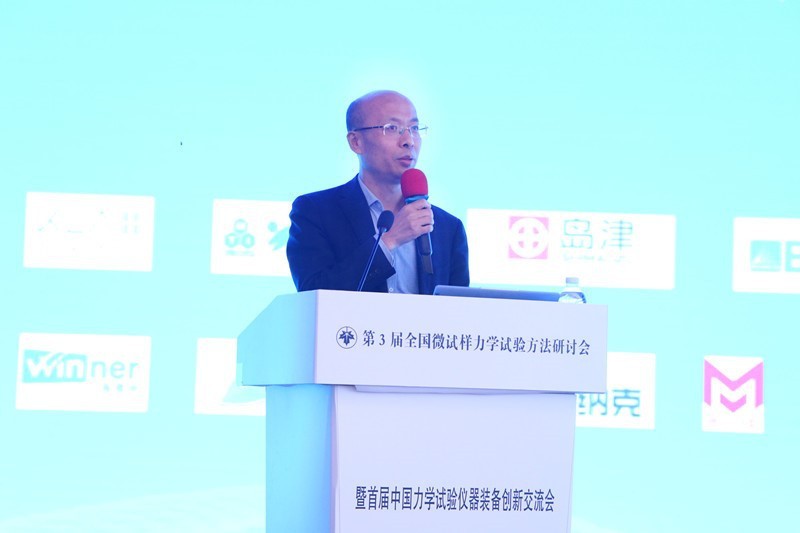
Photo caption: President Xuan Fuzhen delivering a speech and giving a keynote presentation
President Xuan Fuzhen delivered a keynote presentation titled "Strength and Life Prediction Based on Reductionism: Challenges and Reflections." He noted that strength and life prediction represent a timeless research topic, originating from the needs of engineering facility construction and maturing during the era of Newtonian mechanics and the Industrial Revolution driven by steam engines. As we enter a new era of industrial revolution dominated by quantum nanotechnology, big data, and integrated circuits, he argued that it is necessary to re-examine the fundamental definitions of strength and life within the reductionist framework, in order to construct new theoretical research paradigms, experimental methods, and technological solutions suited for the new era.
During the conference, Professor Zhou Guoyan from our university delivered an invited presentation titled "Creep Properties of Small Specimens Based on Crystal Plasticity," and Dr. Wang Qiongqi gave a presentation titled "Advances and Engineering Applications of Minimally Invasive Sampling Technology."
Concurrently with the main conference, the annual meeting of the Working Group on Mechanical Properties Test Methods for Small Specimens of Metallic Materials, under the Technical Committee on Mechanical and Process Performance Test Methods of the National Technical Committee on Steel of Standardization Administration of China, was held. More than 50 committee members and expert representatives from over 40 enterprises, research institutes, universities, and testing institutions across the country attended. Professor Tu Shandong from our university, serving as the working group leader, summarized the group's work in 2025, outlined the work plan for 2026, and presented certificates of appointment to new committee members.
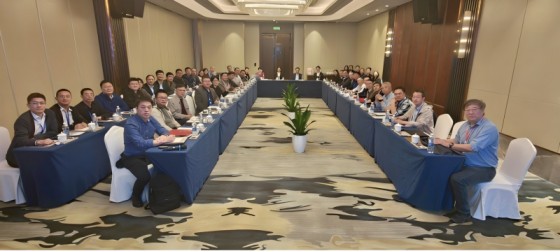
Photo caption: Attendees of the Working Group on Small Specimen Mechanical Testing Methods and the CMIC Committee
The meeting听取了 a report from Professor Zhou Guoyan of our university on the bid to host the 2026 Symposium on Small Specimen Mechanical Testing Methods and China Innovation Exchange on Mechanical Testing Instruments and Equipment. It was unanimously agreed that East China University of Science and Technology would host the event, which is planned to take place in Shanghai around September of next year. The working group's annual meeting also organized discussions and evaluations on a series of new standard project proposals for small specimen mechanical testing methods, including *Metallic Materials—In Situ Test Methods—Part 2: Fatigue Test Methods*, *Metallic Materials—In Situ Test Methods—Part 3: Creep Test Methods*, *Metallic Materials—Plate and Rod-Shaped Small Specimens—Part 2: Creep Test Methods*, and *Metallic Materials—Small Punch Test—Creep Test Methods*. Additionally, the meeting reviewed the阶段性 progress of national standard projects such as *Metallic Materials—Tensile Testing—Part 5: Small Specimen Test Specification* and *Metallic Materials—Beam Bending Small Specimens—Creep Test Methods*, laying a solid foundation for advancing the high-quality development of standardization work in small specimen mechanical testing.
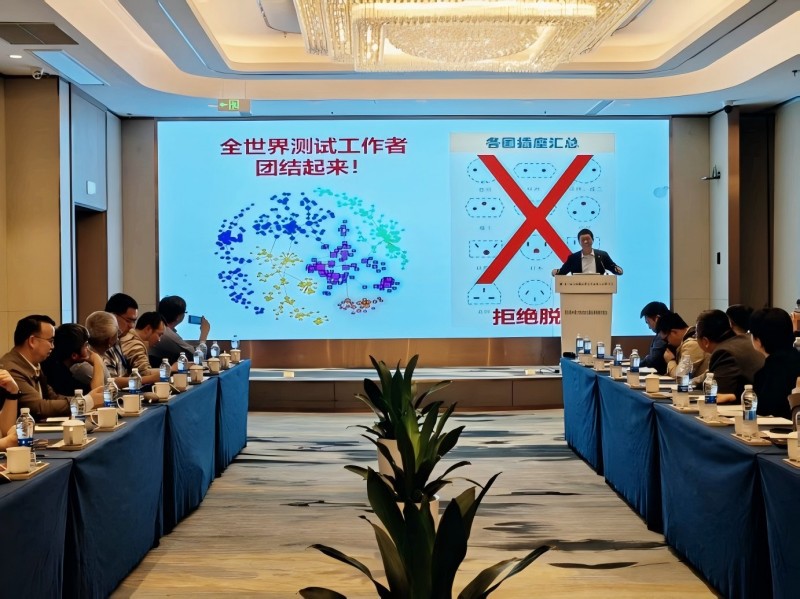
Photo caption: Academician Tu Shandong delivering the working group summary report

