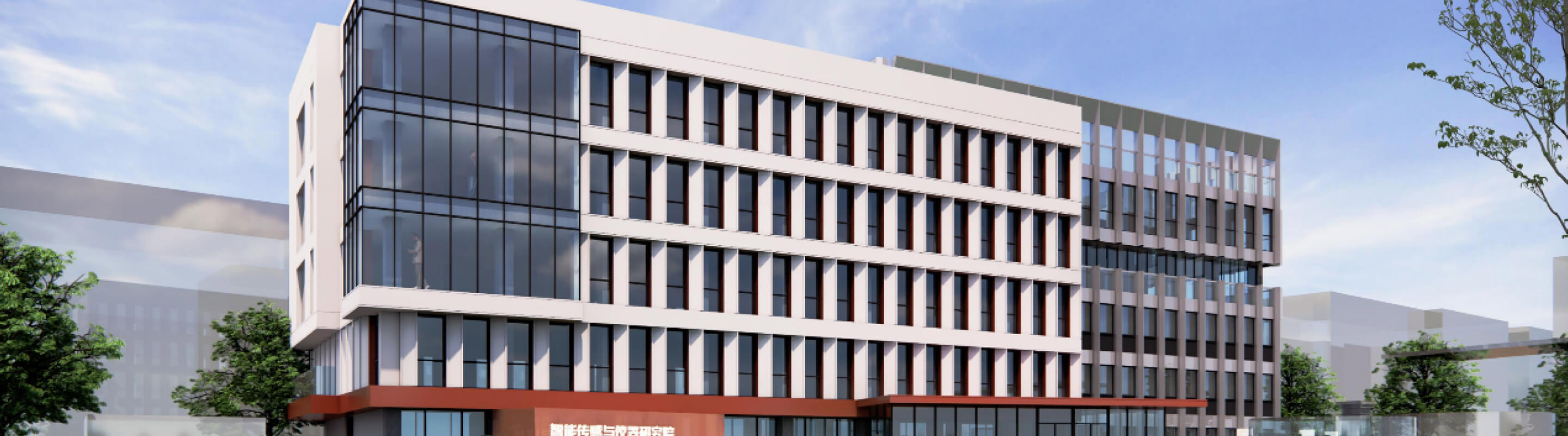
On March 20, the Annual Academic Committee Meeting of the Shanghai Key Laboratory of Intelligent Sensing and Detection Technology and the Advanced Sensing and Detection Technology Innovation Symposium were held. Attendees included Zhou Jing from the Laboratory Division of the Shanghai Municipal Science and Technology Commission; Jiang Zhuangde, Academician of the Chinese Academy of Engineering and Director of the Laboratory’s Academic Committee; Xuan Fuzhen, Director of the Laboratory and President of East China University of Science and Technology (ECUST); Tu Shandong, Academician of the Chinese Academy of Engineering and Deputy Director of the Academic Committee; Wu Tao, President of Shanghai University of Medicine and Health Sciences; Shen Gongtian, Deputy Director of the China Special Equipment Inspection and Research Institute; Liu Jun, Vice President of North University of China; along with Zhao Liming, Dean of the Institute of Science and Technology Development at ECUST; Zhang Xiancheng, Dean of the School of Mechanical and Power Engineering; and more than 20 core laboratory members. The meeting was chaired by Chen Feng, Deputy Director of the Institute of Science and Technology Development.
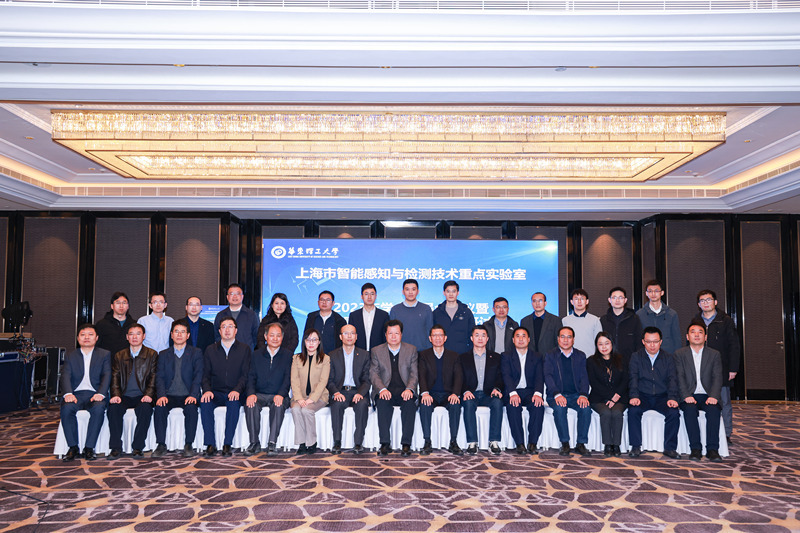
Image Caption: Group photo of leaders from the Shanghai Municipal Science and Technology Commission and members of the Shanghai Key Laboratory of Intelligent Sensing and Detection Technology
Zhao Liming extended a warm welcome to the attending leaders, experts, and scholars. He noted that the 20th National Congress of the Communist Party of China emphasized the importance of “promoting the integrated cluster development of strategic emerging industries and fostering a number of new growth engines such as new-generation information technology, artificial intelligence, and high-end equipment.” In recent years, leveraging its disciplinary strengths, the university has responded to the strategic demands of industrial and industrial intelligence and digital transformation, targeting key areas such as artificial intelligence, the “dual carbon” goals, and biomedicine. It has been approved to establish the Shanghai Key Laboratory of Intelligent Sensing and Detection Technology, focusing on the scientific frontiers and key technologies of intelligent high-end sensors, intelligent health monitoring and detection of major equipment and structures, addressing the urgent needs of high-end equipment intelligence in terms of intelligent sensing, condition awareness, and the frontier theories and bottleneck technologies of detection and monitoring, and cultivating high-end talent to serve national and Shanghai regional development. Over the past year since its establishment, with the guidance and support of the Shanghai Municipal Science and Technology Commission, the Laboratory has formed interdisciplinary research teams integrating mechanics, materials, chemical engineering, physics, chemistry, and information technology, actively exploring new models and mechanisms for organized research aimed at “intelligent transformation,” and has achieved significant interim results.
Zhou Jing extended warm congratulations on the convening of the Academic Committee Meeting of the Shanghai Key Laboratory of Intelligent Sensing and Detection Technology. She introduced the positioning goals and relevant policies for the construction of municipal key laboratories, expressing the hope that the Laboratory would focus on application needs, strengthen capacity building, expand openness and sharing, and strive to become a national-level scientific research platform. She also encouraged the experts and scholars present to provide precise guidance and suggestions for the Laboratory’s development, working to build the Laboratory into an internationally influential innovation base for talent cultivation, scientific research, open collaboration, and serving national development strategies.
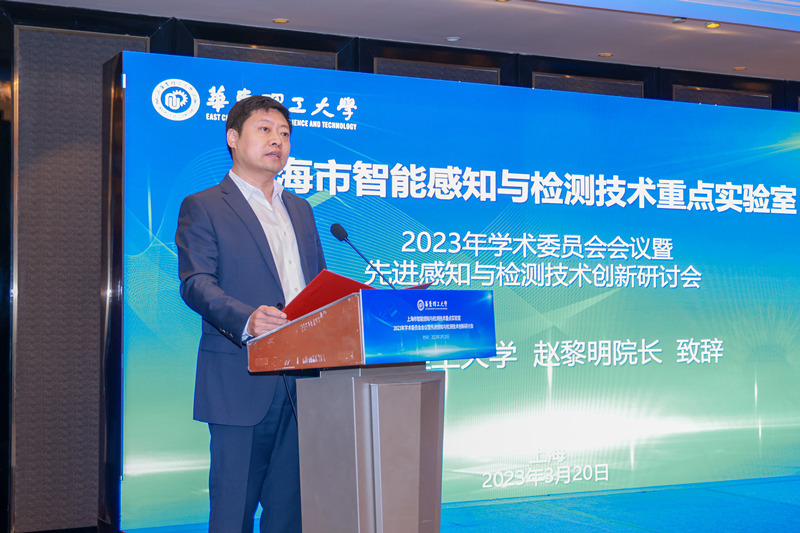
Image Caption: Zhao Liming, Dean of the Institute of Science and Technology Development at ECUST, delivers an opening address
During the meeting, a certificate presentation ceremony was held for the academic committee members and the director of the Shanghai Key Laboratory of Intelligent Sensing and Detection Technology. Xuan Fuzhen and Zhao Liming presented appointment certificates to the Director and expert members of the Laboratory’s Academic Committee.
Academic Committee Director Academician Jiang Zhuangde presided over the academic session. Professor Gao Yang, on behalf of the Laboratory, reported on the past year’s work progress and the new year’s research and development plan. The report detailed the Laboratory’s achievements over the past year across its three research directions: “Functional New Materials and Novel Sensing Principles, Functional Device Structure Design and Manufacturing, Signal Processing and Intelligent Detection,” as well as its future development visions and plans. Three young faculty members—Zhang Bowei, Qiu Xunlin, and Liu Lishuai—delivered academic presentations on their respective research topics: “Bottom-Up Compatible Design and Manufacturing of Advanced Chemical Sensors,” “Design and Piezoelectric Properties of Flexible Heterostructured Electret Sensing Materials,” and “Intelligent Detection and Imaging Methods for Structural Damage Based on Wave Field Information.”
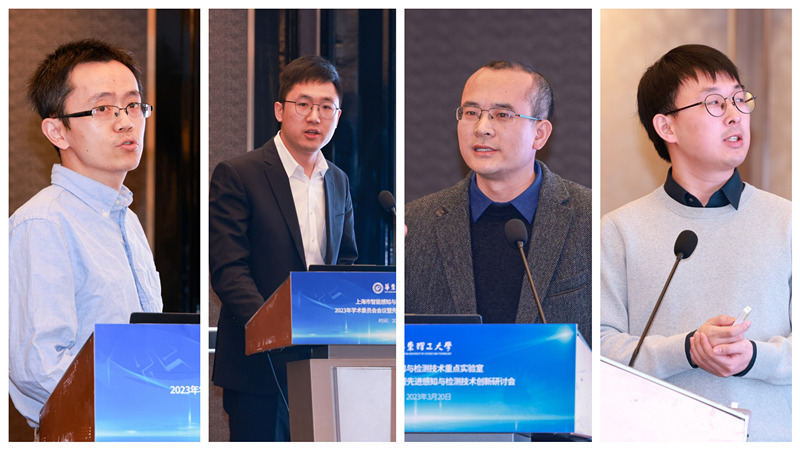
Image Caption: Professor Gao Yang presents the Laboratory’s annual progress report; three young faculty members give presentations
The committee members engaged in in-depth discussions on the Laboratory’s work and development plans. The attending committee members unanimously agreed that over the past year, the Laboratory has established a robust organizational structure, with clear development goals, well-defined research directions, a reasonable talent team composition, distinctive and effective work characteristics, which is of great significance for advancing applied basic research and technological research in the field of intelligent sensing and detection.
Finally, Laboratory Director Professor Xuan Fuzhen expressed gratitude for the guidance and suggestions provided by the attending experts. He stated that the Laboratory would carefully deliberate on the experts’ opinions and suggestions. In the future, the Shanghai Key Laboratory of Intelligent Sensing and Detection Technology will remain oriented toward fundamental frontiers and major national needs, striving through unremitting efforts to become a source of fundamental theories and core technologies in the fields of intelligent sensor innovation and information data processing, as well as a high ground for talent cultivation, making due contributions to the advancement of science and technology and to addressing key core technological challenges in meeting major national needs.

